Foods high in folate (folic acid) are spices, herbs, seeds, nuts, beans, dark green leafy vegetables, whole grains, and even beer! We can get more than enough folate from food. Most healthy people who follow a well-balanced diet don’t need folic acid supplements.
Can I get too much folate from food?
The recommended daily intake of folate from food is 400 mcg. Both for adult women and men. Only pregnant women require much higher dosages.
On the other hand, if you take dietary supplements, you probably need lower dosages. Folic acid from supplements is more bioavailable, as compared to folate from food. It’s estimated that 85% of folic acid from supplements is absorbed, while only 50% of folate of food is bioavailable.[1]
However, high dosages of folic acid from supplements may be bad for you. We shouldn’t exceed the maximum safe dose.
On the contrary, consuming many foods high in folate is pretty safe. Food doesn’t cause folate toxicity.
Animal foods high in folate
As a rule of thumb, foods from animal sources aren’t high in folate. Only liver is particularly rich in folate, containing 260 mcg per 100g.[2]
Most common animal-derived foods contain low amounts of folate. For instance, milk has only 12 mcg of folate per cup, while an egg has only 24 mcg.
Meat, poultry, and seafood contain negligible amounts of folate.
| mcg/100g | |
| liver, beef | 260 |
| crab | 60 |
| eggs | 47 |
| shrimp | 18 |
| turkey | 7 |
Vegan foods high in folate
Plants are the best natural sources of folate!
Spices and herbs, such as basil, rosemary, parsley, and oregano are particularly high in folate. Actually, herbs and spices are the most-nutrient-dense foods. They’re packed with vitamins and health-promoting phytochemicals, containing only a few calories.
Nuts and seeds are excellent dietary sources of folate as well. Peanuts, sunflower seeds, sesame seeds, flaxseeds, and almonds are pretty high in folate.
| food | mcg/100g | food | mcg/100g |
| basil, dried | 310 | bread, barley | 65 |
| rosemary, dried | 307 | kale | 62 |
| peanuts | 246 | Brussels sprouts | 61 |
| oregano, dried | 237 | pumpkin seeds | 58 |
| sunflower seeds | 227 | asparagus | 52 |
| turnip greens | 194 | bread, rye | 51 |
| spinach | 194 | almonds | 44 |
| lentils | 181 | cabbage | 43 |
| chickpeas | 172 | bread, wheat | 42 |
| parsley | 152 | lettuce | 38 |
| kidney beans | 130 | papaya | 37 |
| soybean | 111 | peas | 35 |
| walnuts | 98 | orange | 30 |
| sesame seeds | 97 | tofu | 29 |
| peanut butter | 92 | rice, wild | 26 |
| avocado | 89 | banana | 20 |
| flaxseeds | 87 | lemon juice | 20 |
| white beans | 81 | beet leaves | 15 |
| beetroot | 80 | grapefruit | 13 |
| broccoli | 65 | lemon | 11 |
In fact, dark green leafy vegetables are among the richest foods in folate. Spinach, turnip greens, broccoli leaves, kale, and lettuce are all high in folate.
Also, whole grain bread (wheat, barley, or rye) significantly contributes to the total folate intake. For instance, just a slice of whole wheat bread has about 13 mcg of folate, or the 3% of the recommended daily intake.
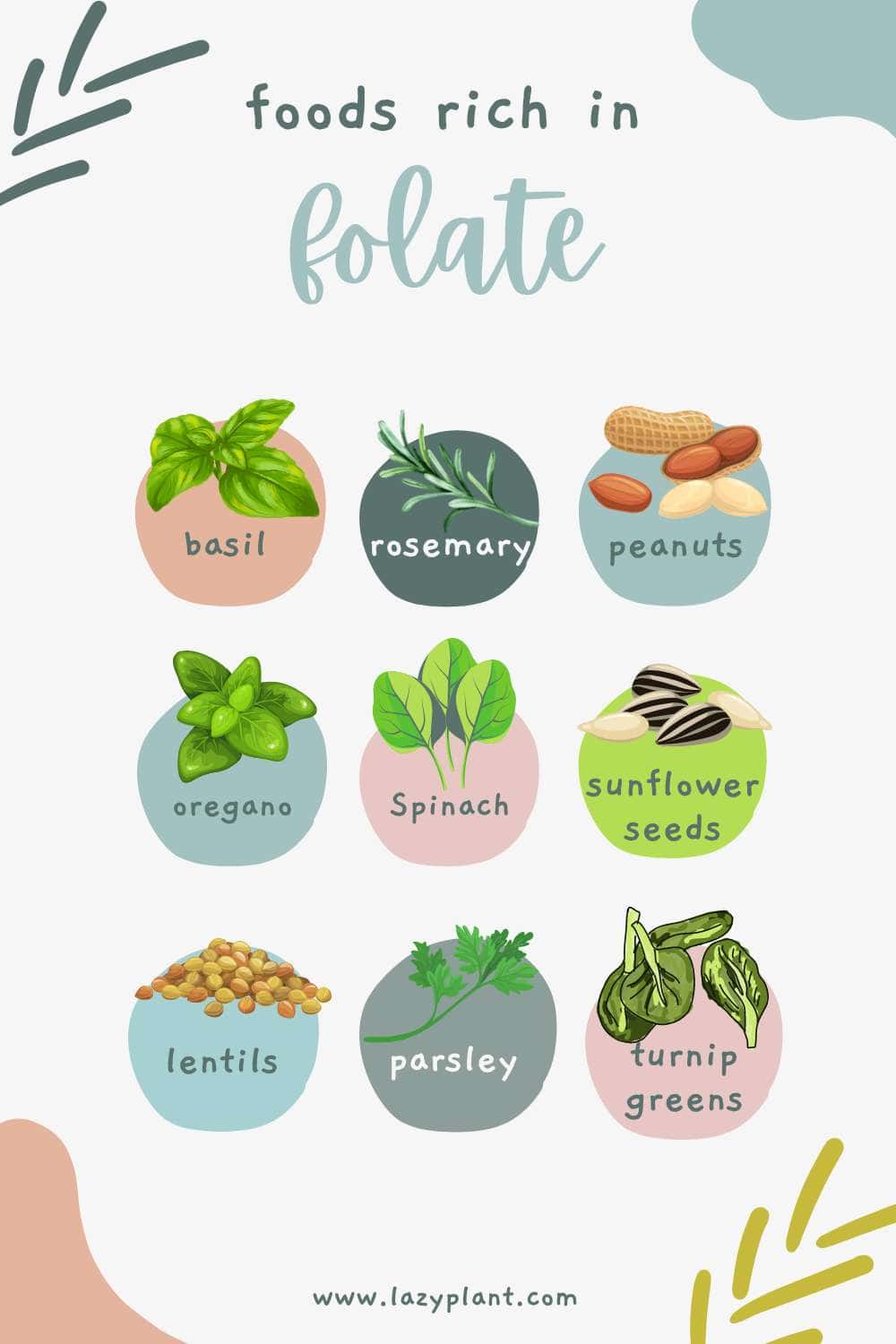
Last, but not least, beans, such as lentils, chickpeas, soybeans, white beans, green peas, and black-eyed peas, are great natural sources of folate.
In addition, you could boost your daily folate intake by consuming fortified foods. Cereal and pasta are common foods enriched with folic acid. Folic acid is pretty stable in heat and light. Additionally, it’s more bioavailable than the natural form (folate).
Hence, you better avoid taking supplements with folic acid if you regularly consume fortified foods or follow a diet with foods high in folate. Above all, you better consult your healthcare provider before taking any supplement or changing your diet.
Beverages high in folate
All beverages are poor in folate. Only beer contains tiny amounts of folate. A glass of beer provides about 5% of the daily recommended intake. As beer is consumed in large amounts by many people, it could contribute to the daily folate intake.
| mcg/100g | mcg/serving | |
| beer | 6 | 21 |
| coffee | 2 | 5 |
| red wine | 1 | 1.5 |
| chamomile tea | 1 | 2 |
On the contrary, other common beverages, such as coffee, wine, or chamomile tea contain only negligible doses of folate.
Health benefits of folate (or folic acid)
Both folate and folic acid are different forms of vitamin B9. Folate is naturally present in food. On the other hand, dietary supplements contain folic acid; the synthetic form of vitamin B9.
Folate (or folic acid or vitamin B9) has many health benefits. It’s involved in protein metabolism, cell division, and serotonin synthesis. Additionally, folic acid is important for weight loss.
Also, folate seems to prevent the development of certain types of cancer, and reduce the risk of cardiovascular disease and stroke, mainly, because it can reduce elevated homocysteine levels.
Moreover, folic acid seems to play a key role in mood and cognitive function.